Confidence Through Clarity. Master the 2027 NBRC.
With the upcoming changes to the board exam, it’s completely natural to feel a bit overwhelmed. But navigating this shift doesn't have to feel like guesswork. We’re here to cut through the academic noise and provide you with clear, practical logic frameworks. Together, we’ll help you bypass the traps and pass your exam with confidence
Foundation: Your Starting Point for RRT Success
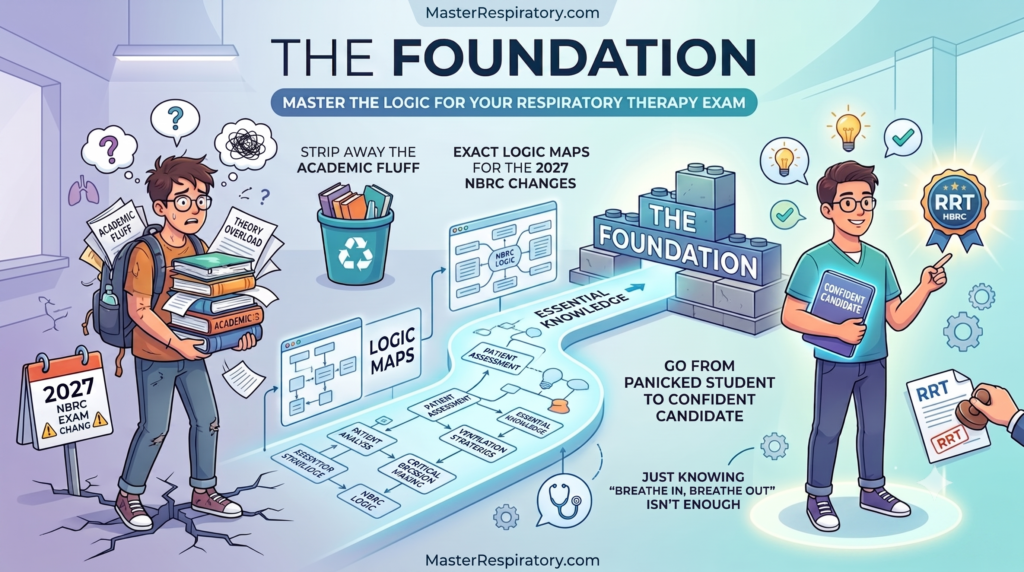
For the students staring down the 2027 NBRC Exam changes. We strip away the academic fluff and hand you the exact logic maps you need to transition from “panicked student” to “confident candidate.” Because let’s be honest—just knowing “breathe in, breathe out” isn’t going to get you that RRT stamp.
NBRC Exam Priority Decoder
Train your brain to see the matrix. Use this tool to instantly isolate the primary clinical problem before you look at the NBRC answer choices.
The Ventilation Protocol
Problem with Carbon Dioxide elimination.
- Acute Respiratory Acidosis
- Elevated PaCO2 (>45 mmHg)
- Inadequate Minute Ventilation (&Vdot;E)
Fix the pH by adjusting Tidal Volume (VT) first, then Respiratory Rate (f). Never touch PEEP/FiO2 for a CO2 problem.
The Oxygenation Protocol
Problem with alveolar membrane diffusion.
- Hypoxemia (PaO2 <60 mmHg)
- Low SpO2 (<90% on Room Air or O2)
- Shunting vs. V/Q Mismatch
If FiO2 is <50%, increase FiO2. If FiO2 is ≥50%, increase PEEP to recruit alveoli and fix shunts.
The 2027 Logic Trap: If *both* are abnormal, always stabilize ventilation (pH/PaCO2) first unless the patient is experiencing severe, life-threatening hypoxemia.
Why Foundation Matters
The 2027 NBRC Exams changes aren’t just a minor update — they represent a fundamental shift in how respiratory therapy competency is evaluated. That means the old study strategies, the recycled flashcard decks, and the “just memorize the normal values” approach won’t cut it anymore. You need a smarter framework. You need logic maps, not just lists.
Foundation is where we strip away the academic fluff and hand you the exact cognitive tools you need to think like a clinician — not just recite like a student.
Who This Is For
This pillar is designed for the student who:
- Feels overwhelmed by the scope of the 2027 exam changes
- Has studied hard but still doesn’t feel “board ready”
- Wants a clear, logical system instead of scattered notes and random practice questions
- Is serious about earning that RRT credential — not just getting by, but truly mastering the material
No posts found!
The 2027 NBRC Structural Weighting Engine
Hover or tap on each logic sector to unpack how the exam translates depth of clinical judgment into question scoring metrics.
Information Gathering
Assessing patient status, chart histories, diagnostic selections, and rapid assessment loops.
Critical Priority: Avoid Over-testingTherapeutics & Interventions
Initiating and modifying mechanical ventilation, hyperinflation therapy, and emergency airway protocols.
Critical Priority: Ventilation PrimacyQuality Control & Safety
Equipment calibration, infection control policies, procedural error mitigation, and structural validation.
Critical Priority: Equipment VerificationThe Clinical Logic Matrix: Ventilation vs. Oxygenation Triage
Train your brain. Follow the path below using your ABG results. Remember the NBRC Golden Rule: Always fix the primary pH/Ventilation issue first.
Evaluate pH
Is the pH normal (7.35-7.45)?
Check PaCO2
Is PaCO2 elevated (>45)?
IF YES: Fix the Ventilation Issue first.
Check PaO2
Is PaO2 low (<80)?
IF YES: Patient is compensating. Address the Oxygenation issue.
Check PaCO2
Is PaCO2 low (<35)?
IF YES: Address hyperventilation/pain before oxygenation.
The Fix: Prioritize Your Adjustments
If Ventilation (pH/PaCO2) is abnormal, adjust Tidal Volume (VT) or Rate (f) first.
If Ventilation is normal but Oxygenation (PaO2) is low, adjust FiO2 or PEEP.
The Master Respiratory Approach
Let’s be honest — just knowing “breathe in, breathe out” isn’t going to get you that RRT stamp. The boards test your ability to think critically under pressure, to synthesize patient data, and to make the right call in complex clinical scenarios. That’s exactly what Foundation prepares you for.
We don’t believe in overwhelming you with information. We believe in giving you the right information, organized in a way that sticks — and that translates directly to exam performance.
No posts found!
How to Use the ABG Matrix Logic Engine
Think of this tool as a digital clinical preceptor standing right next to you at the bedside. Instead of just handing you a generic, automated answer, this engine forces you to “see the matrix” by breaking down the exact physiological checkpoints used to determine an acid-base balance.
Step 1: Enter your patient’s exact pH, PaCO2, HCO3-, and PaO2 values from your case study or practice question.
Step 2: Click “Analyze Matrix Logic.”
Step 3: Trace the logic timeline on the right to see exactly why the values yield that specific clinical interpretation.
Use this sandbox to test your practice exam questions, demystify complex compensation mechanisms, and build the structural muscle memory needed to dominate your clinical rotations.

The ABG Matrix Logic Engine
Master clinical interpretation. Input your values below to instantly decode the acid-base balance and trace the exact logical checkpoints an expert preceptor uses at the bedside.
Awaiting Clinical Metrics
Adjust the values on the left and click analyze to run the logic matrix diagnostics.
Uncompensated Respiratory Acidosis
⚠️ Clinical Reality Check (Educational Disclaimer) While the ABG Matrix Logic Engine is sharp, it is strictly an educational training tool designed to help you master board-style exam logic. In the chaotic environment of a real ICU, algorithms never replace raw clinical judgment. Always look at your patient, verify your waveforms, double-check your equipment, and run your findings through your facility’s protocols. Technology is your co-pilot, but you are the clinician.